





Prof. Dr. Halvard B. Bönig: Long-term blood donation: Is that even safe?
Prof. Dr. Halvard B. Bönig was awarded the title of Honorary Professor of the Faculty of Medicine, University of Ljubljana 2025. The proposal for honorary professorship was submitted by Prof. Dr. Samo Zver.
After the award ceremony, Prof. Dr. Halvard B. Bönig gave a lecture entitled Long-term Blood Donation: Is It Even Safe? Here is the synopsis of his lecture.
Slovenian patients need 60000 units of red blood cells every year. If all eligible adults contributed, each one would donate fewer than 10 units in their lifetime, but unfortunately only 6% of the population are donors. As a society, we owe these unsung heroes the utmost consideration of their safety.
Donors who have given 120 units of blood have produced the equivalent of 3.5 years of extra red blood cell output. Prof. Boenig and colleagues explored, whether as a consequence thereof, premature signs of ageing of the blood producing system are observed. This was possible because as we age, the stem cells, which are at the apex of the blood making machinery acquire small genetic changes which allow them to make more blood cells than would normally come forth from an individual stem cell, and these cells can be recognized because of the small genetic change when sensitive genetic methods are applied.
They studied the blood of men in their sixties, at an age where such genetic changed are found in approximately one quarter of the population – the phenomenon of having such changes is called “clonal hematopoiesis” (CH). Of note, CH is per se not a disease, only a sign of biological age. Some had donated not more than 10 times, and some had donated at least 100 times. They investigated whether CH differed in frequency between these groups, this was not the case, and the same genes were affected in sporadic and frequent donors.
Looking specifically at the effects that the genetic changed had for gene function, they observed that in frequent donors mutations were enriched which promote the making of more red blood cells, and that the frequency of mutations of concern, that could later lead to disease, was, if anything, lower in frequent than in sporadic donors. This very deep genetic investigation unearthed no findings which would suggest that long-term frequent blood donation is anything but safe.
For interested readers, the work, which was published in the Journal of the American Society for Hematology, “Blood”, can be accessed under the following link: Clonal hematopoiesis landscape in frequent blood donors.
Karpova D , Encabo H H , Donato E et al. Clonal Hematopoiesis Landscape in Frequent Blood Donors. Blood 2025 . DOI: 10.1182/blood.2024027999
Foto: Metod Perme/UL MF

Prof. Dr. Halvard B. Bönig was awarded the title of Honorary Professor of the Faculty of Medicine, University of Ljubljana.
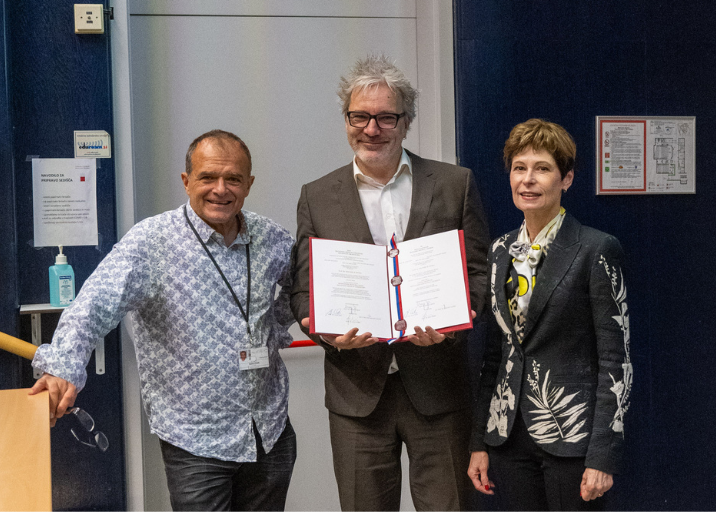
The proposal for honorary professorship was submitted by Prof. Dr. Samo Zver.

After the award ceremony, Prof. Dr. Halvard B. Bönig gave a lecture entitled Long-term blood donation: Is that even safe?
