



New Pediatric Diagnostic Score for Early Detection of Familial Hypercholesterolemia in Children: FH-PeDS
We are pleased to announce that the prestigious international journal European Journal of Preventive Cardiology has published an original research article entitled “Proposal of a Familial Hypercholesterolemia Pediatric Diagnostic Score (FH-PeDS).”
The article is available here.
Background & Aim
Familial hypercholesterolemia (FH) is the most common inherited metabolic disorder, significantly increasing the risk of atherosclerotic cardiovascular events from childhood. Although genetic testing is the gold standard, its cost and limited availability often make it impractical. Existing adult-derived diagnostic criteria underperform in pediatric populations, creating a need for a tailored pediatric approach. This study aimed to:
1. Evaluate five established clinical FH criteria in two pediatric cohorts;
2. Develop a simple point-based FH-PeDS score;
3. Create an interpretable machine-learning model (ML-FH-PeDS) for integration into web applications.
Methods
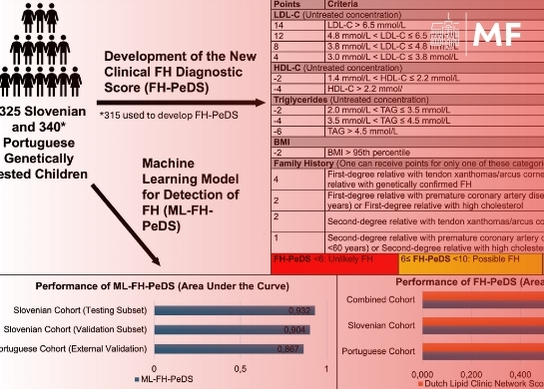
The study included 1,360 children with suspected FH from Slovenia and 340 from Portugal. All participants underwent genetic analysis as the reference standard. FH-PeDS is based on lipid profile parameters (LDL-C, HDL-C, and triglycerides), body mass index, and family history.
Key Results
· All existing clinical FH criteria combined identified only 47.4% of genetically confirmed FH cases, while 10.9% were missed entirely by all criteria.
· FH-PeDS outperformed the Dutch Lipid Clinic Network score with an AUC of 0.897 in both cohorts.
· ML-FH-PeDS achieved an AUC of 0.932 on training and 0.904 on testing, maintaining high accuracy on external validation (0.867).
Implications & Next Steps
We recommend using FH-PeDS as a first-line screening tool, with ML-FH-PeDS as an additional, interpretable confirmation layer—particularly where genetic testing is unavailable. Both tools will soon be accessible via an online application, facilitating early FH detection and treatment, reducing long-term cardiovascular risk, and optimizing healthcare resource use. Future work will include prospective studies and validation in non-European populations.
Role and Contribution of the University of Ljubljana, Faculty of Medicine (UL MF)
In this project, UL MF provided comprehensive support and expert guidance. Doctoral students Jan Kafol, Jaka Šikonja, and Matej Mlinarič contributed to data collection, performed statistical analyses, and assisted in the development and validation of the clinical FH-PeDS and ML-FH-PeDS models. Professor Urh Grošelj, MD, PhD, from the Departments of Paediatrics and Medical Ethics, guided the study design, supervised the methodology, and oversaw the editorial preparation of the final publication. The core team also included Professor Tadej Battelino, MD, PhD, from the Department of Paediatrics. Additionally, several other habilitated researchers from UL MF contributed to various phases of the study as part of the extended author group. The University of Ljubljana, under its agreement with Oxford University Press, funded and facilitated open access publication.
Significance of the Research
The implementation of FH-PeDS and ML-FH-PeDS in routine clinical practice enables the early identification of children at the highest risk, allowing for timely interventions (dietary, lifestyle, pharmacological) to prevent the development of cardiovascular complications. Reducing cardiovascular disease from early childhood translates into a lower burden on the healthcare system and society in adulthood, as well as improved quality of life for individuals. Moreover, more reliable screening tools help reduce unnecessary genetic testing and associated costs, thereby supporting more rational use of healthcare resources.
Authors & Collaborators
Jan Kafol, Beatriz Miranda, Rok Sikonja, Jaka Sikonja, Albert Wiegman, Ana M. Medeiros, Ana C. Alves, Tomáš Freiberger, Barbara A. Hutten, Matej Mlinarič, Tadej Battelino, Steve E. Humphries, Mafalda Bourbon, Urh Grošelj, and the FH-PeDS Collaborators.
We believe this contribution will substantially advance national and international efforts to improve early FH detection in children and thereby enhance cardiovascular disease prevention.