


World Greek Language Day at the Faculty of Medicine, University of Ljubljana
UNESCO has designated 9 February as World Greek Language Day, thereby recognising the Greek language for its significant contribution to the development of natural sciences, philosophy and medicine. Greek is one of the foundational languages of European scientific thought. Since antiquity, the development of medicine has been closely linked to a specialised medical language that is largely based on Greek and Latin roots.
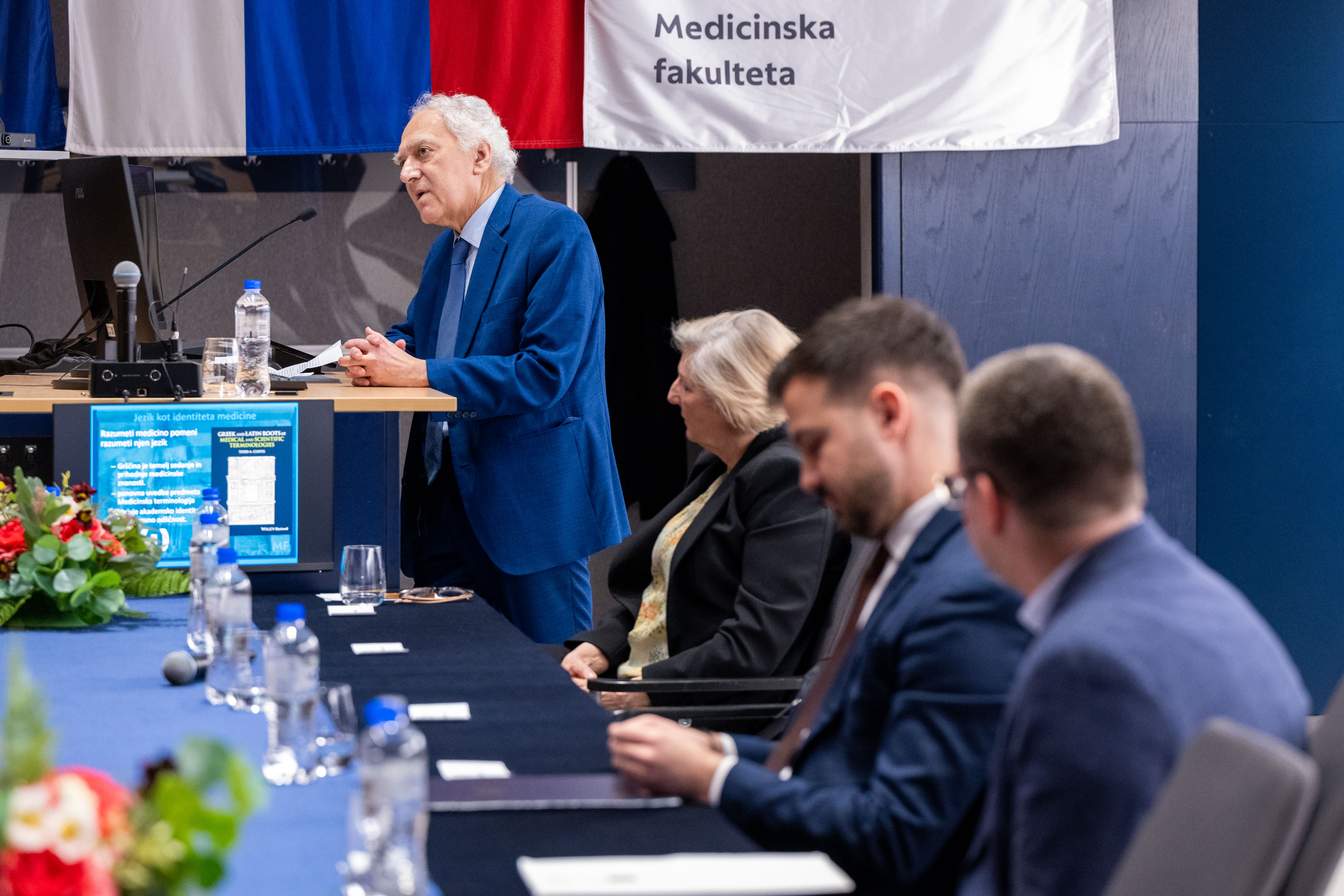
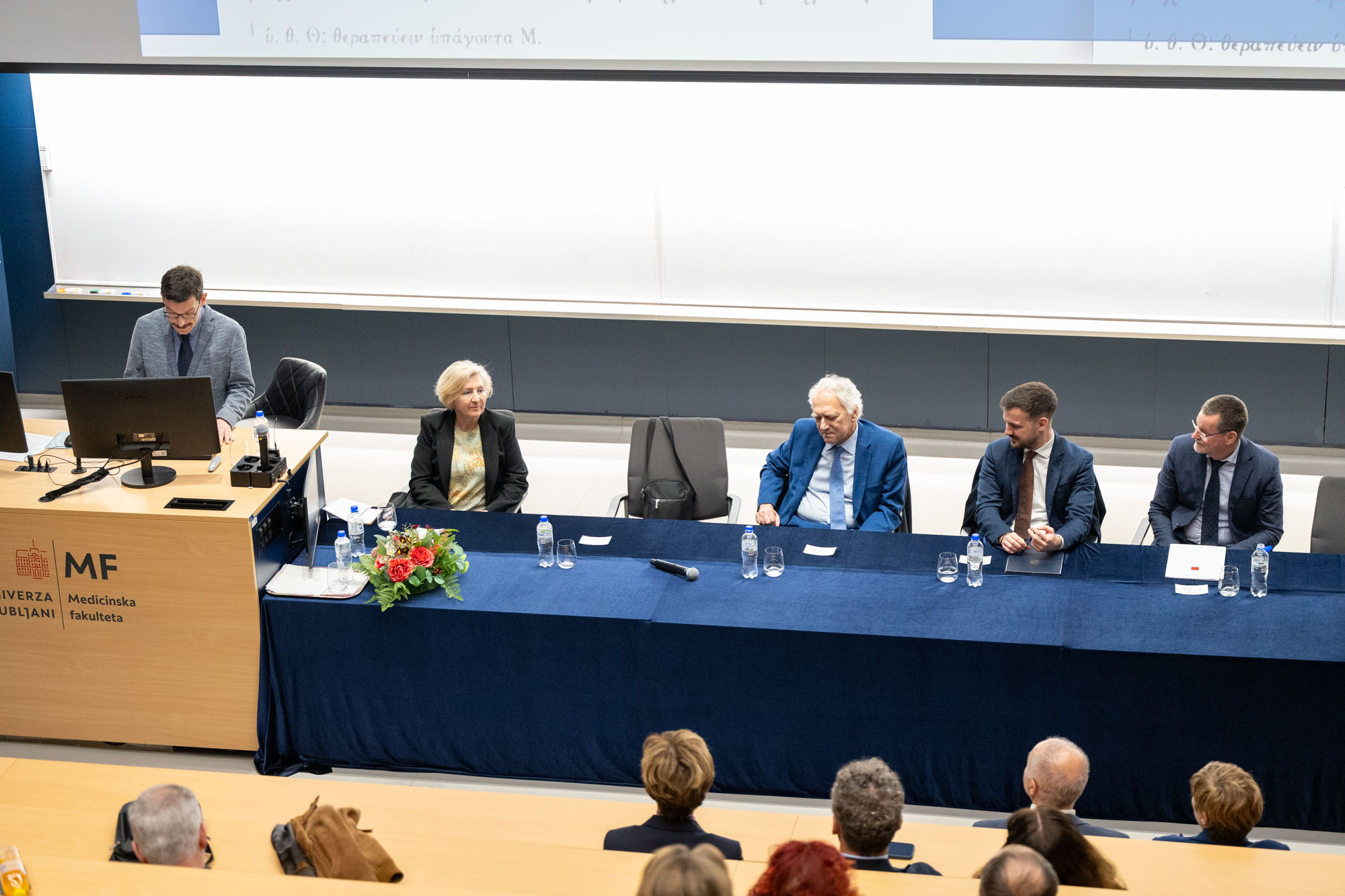
On 2 March 2026, the Faculty of Medicine of the University of Ljubljana marked the importance of the Greek language for medicine and dental medicine with a ceremonial event. At the event, the role of the Greek language in medical science was highlighted by His Excellency Argyris Makris, Ambassador of the Hellenic Republic to Slovenia; Mr Haris Papadakis, Consul of the Hellenic Republic in Slovenia; Professor Sergej Pirkmajer, MD, PhD, Vice-Dean of the Faculty of Medicine; as well as Professor Erika Cvetko, MD, PhD, and Professor Tomaž Marš, MD, PhD.
In his address, Ambassador Argyris Makris presented the origins of several words that we use in everyday communication and that also carry profound meaning in the field of medicine. He highlighted the enduring influence of the Greek language on the European intellectual tradition and noted that many fundamental concepts of modern science originate in the Greek linguistic and cultural sphere.
Professor Sergej Pirkmajer highlighted that this year also marks the 250th anniversary of the birth of Ioannis Kapodistrias, one of the most important Greek statesmen, who was closely connected with Koper and Ljubljana, and outlined the historical development of medical professional terminology. He emphasized that knowledge of terminological roots is essential for understanding medical terms and for their rational use. He concluded that if the roots reaching back to ancient Greece were severed, the corpus of medical terms used in everyday practice would lose its depth and meaning and become largely illogical and therefore less useful—merely a lifeless collection of incomprehensible words.
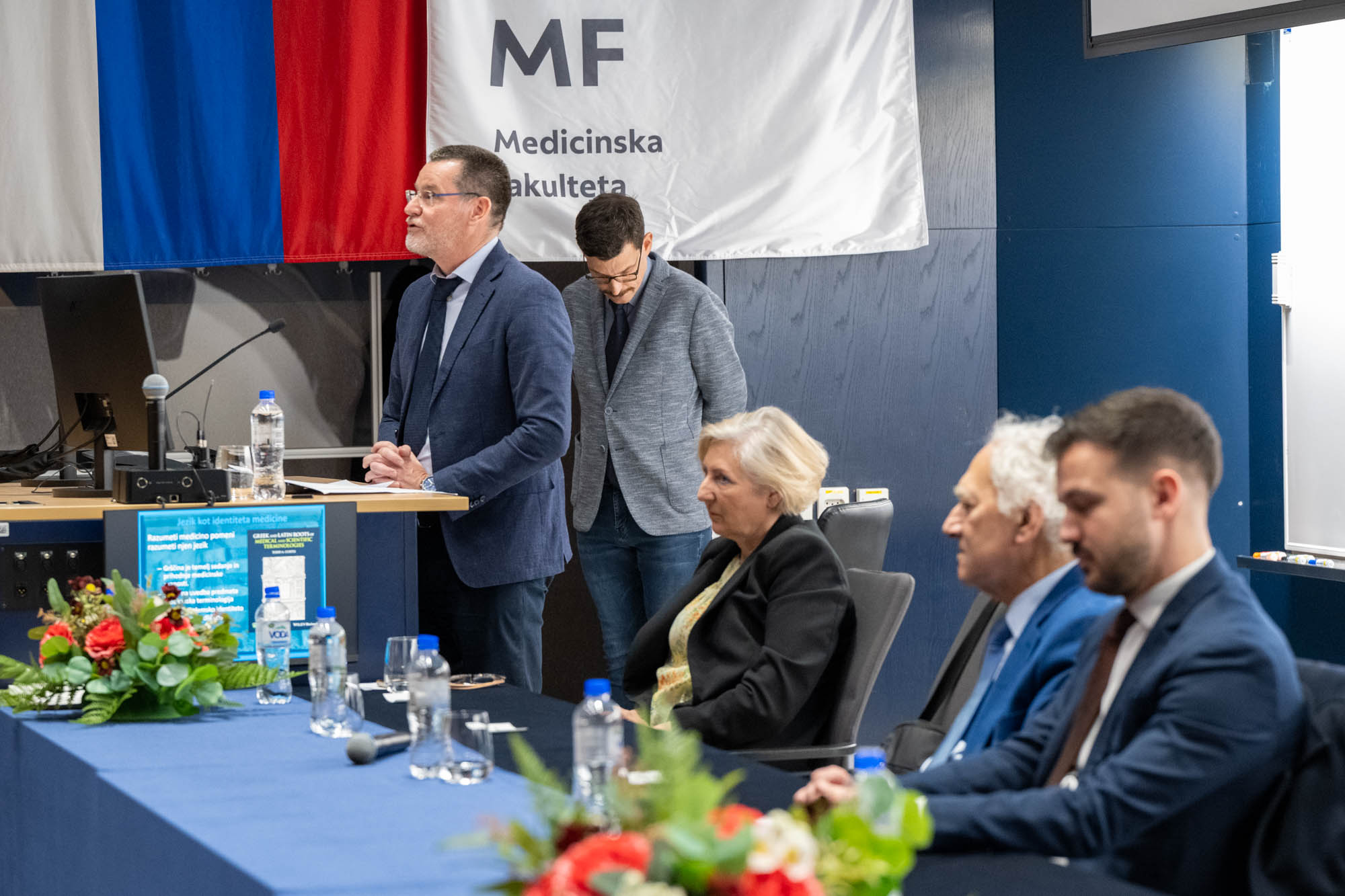
“Medicine speaks a language that was born in ancient Greece. By celebrating World Greek Language Day, we also recognise the intellectual continuity of medicine, as the Greek language enabled medicine to develop into a rational, systematic and scientific discipline. By teaching and preserving medical terminology, we reaffirm the importance of scientific precision and academic excellence. Since the time of Hippocrates, medicine has developed its identity through terminology. When we pronounce a diagnosis, write a medical report or formulate a scientific hypothesis today, we do so in a language whose Greek and Latin roots reach back more than two thousand years,” emphasised Professor Tomaž Marš.
The central part of the event was a lecture by Mr Haris Papadakis, Consul of Greece in Slovenia, entitled “Elements of the Greek Language in Modern Medical Terminology: The Case of the Privative Alpha” («Στοιχεία της ελληνικής γλώσσας στη σύγχρονη ιατρική ορολογία: η περίπτωση του στερητικού άλφα»). In his engaging and insightful lecture, he clearly explained the origins of numerous medical terms that contain the so-called privative alpha, a Greek linguistic element expressing the absence or negation of a particular property or condition. Mr Haris Papadakishas emphasized the privative alpha in modern medical terminology. The privative alpha is a prefix in the Greek language that indicates deprivation, corresponding to the suffix -less in English. Indicative examples include words from medical terminology, such as apraxia, aphasia, anodynia and analgesic."
The event highlighted the profound connection between medicine and Greek cultural and scientific heritage and once again underscored the importance of medical terminology as one of the fundamental elements of medical education.
Photo: metod Perme/UL MF